Fight Fires with Autonomy

Happy Sunday folks,
Welcome to The Aerial Economy. Today I’m thrilled to share a non-military use case for autonomous drone technology.
I’m not talking about fast food delivery or last-mile logistics.
I’m talking about fighting fires, and ultimately preserving peace and tranquility in our natural environment.
Enter Seneca

Seneca is a resilience-technology company building autonomous drones and AI-driven software to support firefighters and protect communities from wildfires. Founded by Stuart Landesberg (previously of Grove Collaborative), the company is based in the San Francisco Bay/Sausalito area.
On October 20th, Seneca announced ~$60 million in venture funding — one of the largest early-stage raises in fire-tech history.
Its goal is clear: create a rapid-response aerial network capable of attacking fires within minutes, before traditional air assets can be deployed.
This matters because wildfires don’t start as infernos.

They start small - a spark, an ember, a wind-driven flare-up - and grow unchecked in the critical early moments when aircraft are grounded, crews are limited, and visibility is low.
This “pre-dawn gap” is where most destruction begins. And Seneca’s drones are designed to fight in that void.
Fully autonomous, capable of carrying suppressant or foam, and built to identify and extinguish fires at the ember stage, its drones give fire crews something they’ve never had: persistent, scalable, round-the-clock aerial coverage.
Firefighting drones are a force multiplier, not a job replacer.
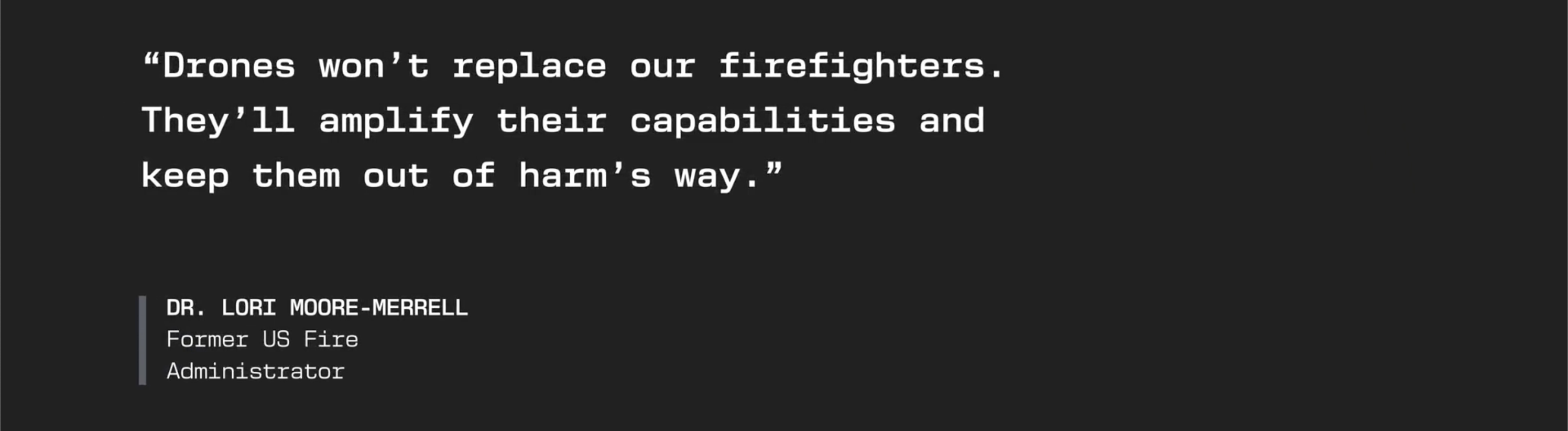
Seneca’s current collaborations include fire agencies within California and Colorado, regions where climate, terrain, and population growth have heightened wildfire risk.
Folks - this isn’t just a feel good story for humanity, the financial stakes are significant.
In the United States, wildfires impose an estimated annual economic burden between $400B - $900B.
And we’re not just talking about the suppression costs, but 2nd and 3rd degree ripple effects — destroyed homes, insurance losses, business interruptions, smoke-related health impacts, and ecosystem degradation.
It’s well known, wildfires pose a major threat to the health and safety of our environment and local communities.
I’m thrilled to see The Aerial Economy resolve real issues once deemed impossible. This is just the beginning of a safer, more resilient world.
Here are some additional resources to learn more:
📖 Drones - UAS for Emergency Response Services (Published 8/7/2017)
📺 A Modern Arsenal For The Highest Fire Risk In History
🗒️ Seneca Brings In $60M To Develop Fire Suppression Drones
🗒️ Aspen Fire Protection District Considering AI-Powered Drones To Fight Wildfire
📺 Fire Drill Held At World Heritage Site In Central Japan
🌐 The Rex Pure Play Drone ETF — $DRNZ
If you stumble upon other unconventional drone use-cases, send them my way. I want to spotlight the companies and ideas reshaping our society.
Disclosure: This is not financial advice.